✍️ Written by Waqas | ⏱️ Read Time: 14 minutes | 📅 Last Updated: May 18, 2026
Table of Contents
Introduction
Cost of Living in Riyadh 2026 is one of the most searched topics for expats, professionals, students, and families planning to move to the capital of Saudi Arabia. Riyadh is the Kingdom’s largest city and a major center for business, technology, and development under Saudi Vision 2030. With growing job opportunities, modern infrastructure, and a high standard of living, thousands of people relocate to Riyadh every year.
However, living expenses in Riyadh can vary significantly depending on your lifestyle, location, and family size. Housing, groceries, transportation, utilities, healthcare, and schooling are the main monthly costs to consider. While some areas of Riyadh offer luxury living, there are also many affordable options for singles and families looking to manage their monthly budget wisely.
In this updated 2026 guide, we’ll break down the real cost of living in Riyadh, including apartment rent, food prices, transport expenses, utility bills, and average monthly budgets, so you can better understand how much money you may need to live comfortably in Saudi Arabia’s capital.
Detailed Cost Breakdown
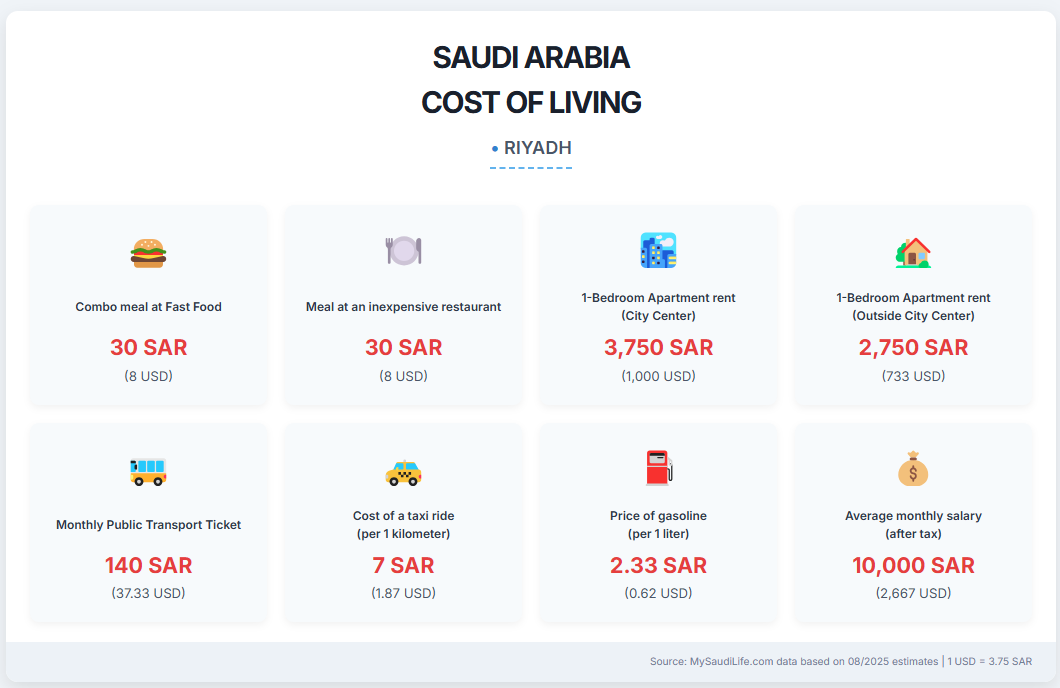
Below is an estimated breakdown of common expenses in Riyadh, shown in Saudi Riyals (SAR) with their approximate value in US Dollars (USD). For reference, 1 USD is roughly equal to 3.75 SAR, though exchange rates may change slightly over time.
1- Accommodation
The cost of living in Riyadh is greatly influenced by housing. The city offers a wide range of accommodation options—from affordable apartments in local neighborhoods to premium villas in gated expat compounds. Rental prices vary depending on location, facilities, and the property’s condition.
Accommodation Costs in Riyadh (SAR)
| Category | Average Price (SAR) | Range (SAR) |
|---|---|---|
| Apartment (1 bedroom) in City Centre (per month) | 4,529.97 | 2,500 – 8,000 |
| Apartment (1 bedroom) Outside of Centre (per month) | 2,986.54 | 2,000 – 4,500 |
| Apartment (3 bedrooms) in City Centre (per month) | 7,740.62 | 4,000 – 19,000 |
| Apartment (3 bedrooms) Outside of Centre (per month) | 4,056.00 | 2,000 – 7,200 |
| Price per Sq. Ft. to Buy Apartment in City Centre (one-time purchase) | 736.91 | 529.54 – 1,099.99 |
| Price per Sq. Ft. to Buy Apartment Outside of Centre (one-time purchase) | 490.52 | 325.16 – 854.70 |
| 3-4 Bedroom Villa in a Compound (per year) | 140,000 | 80,000 – 200,000 |
Factors Affecting the Cost of Living in Riyadh: Rent and property prices vary based on several key factors. Newer buildings and apartments located near business districts like King Abdullah Financial District (KAFD) tend to be more expensive. Popular expat neighborhoods such as Al Olaya, the Diplomatic Quarter, and Al Hamra also command higher rents. Furnished apartments come at a premium, while villas and compounds offer a Western-style living experience with shared facilities like pools, gyms, and schools, along with enhanced security—making them more costly but comfortable for families.
2- Transportation Costs in Riyadh
Getting around Riyadh is generally affordable, whether you use public transport, taxis, ride-hailing apps, or your own car. Understanding these costs can help you plan your monthly budget and overall cost of living in Riyadh.
Public Transportation
The Riyadh Metro is modern, fast, and comfortable. A two-hour ticket costs around SAR 4, while a monthly 30-day pass is about SAR 140. Tickets can be purchased through the Darb app, Darb card, or using Apple Pay/bank cards.
Riyadh also has a comprehensive public bus network managed by SAPTCO. Single-trip fares start at SAR 4 for two hours, and monthly passes are available for SAR 140, making buses a budget-friendly option for daily commuting.
Ride-Hailing & Taxis
Getting a taxi in Riyadh is easy. Popular ride-hailing apps like Uber, Careem, and the official national app Taxi – أجرة are widely used. For phone-based bookings, you can call SAFWA Taxi at +966 92 001 0068. Other local apps such as Kaiian and Jeeny are also available for convenient ride bookings throughout the city. Taxi fares usually start at SAR 5–6, with additional charges per kilometer, while ride-hailing apps offer flexible pricing for short and long trips.
Intercity Travel
Traveling between cities from Riyadh is convenient with multiple options. You can use intercity buses operated by SAPTCO or SAT, which offer various routes and amenities. For train travel, check the Saudi Railways Organization (SAR) website for schedules and ticket prices. If you prefer a more personalized or direct experience, private transfer services like Yelo Limousine, NAYLAM, or Uber Intercity are also available.
Car Ownership & Fuel
Riyadh is a car-centric city, so owning or renting a vehicle is an important part of the cost of living in Riyadh.
- New Cars: A brand-new compact car typically costs between SAR 60,000 and 90,000 (approximately USD 16,000–24,000). Larger or luxury models are significantly higher.
- Used Cars: Prices for second-hand vehicles vary widely depending on the model, year, and condition. Cars can start from SAR 15,000, with premium models costing more.
- Car Rentals: Monthly car rentals usually range from SAR 1,500 to 3,000, depending on vehicle type and rental duration.
Fuel Costs
Fuel is generally affordable in Riyadh, but monthly usage can add up depending on how much you drive. Here’s the latest pricing:
| Fuel Type | Price (SAR/Liter) |
|---|---|
| Gasoline 91 | 2.18 SAR per liter |
| Gasoline 95 | 2.33 SAR per liter |
| Diesel | 1.66 SAR per liter |
| LPG | 1.09 SAR per liter |
| Kerosene | 1.59 SAR per liter |
Tips to Save on Transportation
- Use ride-hailing apps for short trips to save on fuel.
- Consider a metro pass once more lines open for daily commuting.
- Plan long-distance travel with buses or trains to reduce car-related expenses.
3- Food & Groceries in Riyadh
Food and groceries are a significant part of the cost of living in Riyadh, but you can manage expenses depending on where and how you shop.
- Monthly Grocery Costs:
- Single person: Around SAR 800–1,500
- Family of 4: Around SAR 2,500–4,000
Shopping at hypermarkets like Carrefour, Lulu, or Panda can save money, especially when buying in bulk. Imported Western products are generally more expensive, so opting for locally sourced goods can help reduce costs.
- Eating Out:
- Budget meal (local restaurants or shawarma): SAR 20–40 per person
- Mid-range restaurant (per person): SAR 80–150
- Fine dining (per person): SAR 200+
Riyadh has a wide range of restaurants, from inexpensive local eateries to premium international dining, making it easy to choose based on your budget.
Here’s a look at typical prices for groceries and daily essentials in Riyadh, so you can plan your budget better.
| Item | Average Price (SAR) | Range (SAR) |
|---|---|---|
| Milk (regular, 1 gallon) | 24.10 | 18.93–34.07 |
| Loaf of Fresh White Bread (1 lb) | 4.13 | 1.81–7.26 |
| Rice (white, 1 lb) | 3.79 | 2.27–5.44 |
| Eggs (regular, 12 pcs) | 9.31 | 6.00–19.60 |
| Local Cheese (1 lb) | 13.92 | 8.16–29.94 |
| Chicken Fillets (1 lb) | 14.24 | 7.89–20.41 |
| Beef Round (1 lb) | 22.16 | 13.61–27.22 |
| Apples (1 lb) | 3.81 | 2.27–4.99 |
| Banana (1 lb) | 2.86 | 2.27–4.54 |
| Oranges (1 lb) | 3.02 | 1.59–6.80 |
| Tomato (1 lb) | 2.82 | 1.81–4.54 |
| Potato (1 lb) | 2.20 | 1.36–4.08 |
| Onion (1 lb) | 2.44 | 1.36–4.54 |
| Lettuce (1 head) | 4.67 | 1.50–8.00 |
| Water (1.5 L bottle) | 2.23 | 1.80–3.50 |
| Bottle of Wine (Mid-Range) | 19.00 | 5.00–50.00 |
| Domestic Beer (0.5 L) | 6.48 | 5.00–12.00 |
| Imported Beer (12 oz) | 7.76 | 5.00–12.00 |
| Cigarettes (Marlboro, 20 pack) | 27.00 | 25.00–30.00 |
| Olive Oil (1 liter) | 28.00 | 20.00–35.00 |
| Sugar (1 kg) | 5.50 | 4.00–7.00 |
| Butter (1 lb) | 14.00 | 10.00–20.00 |
Dining out in Riyadh offers options for every budget. Here’s a breakdown of common restaurant and cafe prices.
| Item | Average Price (SAR) | Range (SAR) |
|---|---|---|
| Meal, Inexpensive Restaurant | 31.50 | 20.00–50.00 |
| Meal for 2 People, Mid-range, Three-course | 200.00 | 120.00–400.00 |
| McMeal at McDonalds (or Equivalent) | 30.00 | 28.00–38.00 |
| Domestic Beer (1 pint draught) | 8.00 | 5.00–15.00 |
| Imported Beer (12 oz small bottle) | 8.00 | 5.00–12.00 |
| Cappuccino (regular) | 16.48 | 7.00–23.00 |
| Coke/Pepsi (12 oz small bottle) | 2.93 | 2.50–4.00 |
| Water (12 oz small bottle) | 1.25 | 1.00–3.00 |
Tips to Save on Food & Groceries:
- Cook at home whenever possible to save money.
- Buy local fruits, vegetables, and staples instead of imported goods.
- Take advantage of promotions at large supermarkets.
- Consider meal planning to avoid unnecessary spending.
4- Utilities & Communication in Riyadh
Utilities like electricity, water, and internet are an important part of the cost of living in Riyadh. Prices vary depending on apartment size, usage, and provider. Here’s an overview of typical monthly expenses:
- Electricity & Water:
- Small apartment: SAR 200–500
- Larger apartment or villa: SAR 500–1,500+
Usage, especially air conditioning in summer, greatly affects the bill.
- Internet:
Fiber optic connections are widely available, with fast speeds and reliable service.- Home Internet (50–100 Mbps): SAR 200–350
- Mobile Phone Plans:
Saudi Arabia has competitive mobile plans with a variety of data and call packages.- Postpaid unlimited data & calls: SAR 100–250
Here’s a quick look at typical monthly utility and communication costs in Riyadh.
| Utility / Service | Average Price (SAR) | Range (SAR) |
|---|---|---|
| Electricity & Water (Small Apartment) | 350 | 200–500 |
| Electricity & Water (Large Apartment/Villa) | 1,000 | 500–1,500+ |
| Home Internet (50–100 Mbps) | 275 | 200–350 |
| Mobile Phone Plans (Postpaid, Unlimited) | 175 | 100–250 |
Tips to Save on Utilities:
- Turn off lights, AC, and appliances when not in use.
- Use energy-efficient appliances.
- Compare internet and mobile plans for better deals.
5- Healthcare in Riyadh
Healthcare is an essential part of the cost of living in Riyadh, especially for expats. Saudi Arabia has a well-developed healthcare system with both public and private options. Most expats are required to have health insurance, which is often provided by employers.
- Health Insurance:
Employer-provided health insurance is common. Private plans can cost SAR 3,000–10,000+ per year, depending on coverage. Popular providers include Bupa Arabia, MedGulf, Tawuniya, tameeni, and Al Rajhi Takaful. - Hospitals & Clinics:
Riyadh offers world-class healthcare facilities. Some of the most trusted hospitals are:- King Faisal Specialist Hospital & Research Centre
- Riyadh Military Hospital (King Saud Medical City)
- Dr. Sulaiman Al Habib Medical Group
- King Khalid University Hospital
- Al Mouwasat Hospital
- Pharmacies:
Pharmacies are easily accessible across the city. Popular chains include Tadawi Pharmacy, White Pharmacy, Nahdi Medical Company, Al Nahdi Pharmacy, and Al-Dawaa Pharmacies. - Doctor Visits:
- General Practitioner: SAR 100–300 per visit (without insurance)
- Specialist: Higher fees depending on specialty
- Medication:
Prescription and over-the-counter medications are generally affordable. Local alternatives often cost less than imported brands.
Here’s a summary of typical healthcare costs in Riyadh, including insurance, doctor visits, and medications.
| Healthcare Service | Average Price (SAR) | Range (SAR) |
|---|---|---|
| Private Health Insurance (Annual) | 6,500 | 3,000–10,000+ |
| Doctor Visit (General Practitioner) | 200 | 100–300 |
| Medication (Monthly Average) | 150 | 50–300 |
Tips to Save on Healthcare:
- Confirm your employer covers your health insurance.
- Compare clinics, hospitals, and pharmacies for cost-effective options.
- Use government or public hospitals if eligible.
- Keep a list of trusted pharmacies for recurring medications.
6- Education in Riyadh
For expat families, education is a significant part of the cost of living in Riyadh. The city offers a wide range of options, from local schools to international institutions. Tuition fees can vary depending on the curriculum, grade level, and school facilities.
- Popular International Schools in Riyadh:
- Riyadh International Community School (RICS) – British curriculum
- American International School-Riyadh (AIS-R) – American curriculum
- British International School Riyadh (BISR) – British curriculum
- Multinational School Riyadh (MSR) – IB and Indian curriculum
- International Indian School Riyadh (IISR) – Indian curriculum
- International School Fees:
Annual tuition fees typically range:- Kindergarten/Primary: SAR 25,000–60,000
- Secondary: SAR 40,000–90,000+
- Local Schools:
Saudi government schools are free for citizens, but expats often prefer private or international schools for quality education and English-language instruction. - Factors Affecting Cost:
- Curriculum type (British, American, IB, Indian, etc.)
- Grade level and age of the student
- Facilities such as labs, sports, and extracurricular activities
- Proximity to your residence
Here’s an overview of typical annual tuition fees for international schools in Riyadh.
| Education Level | Average Annual Fee (SAR) | Range (SAR) |
|---|---|---|
| Kindergarten / Primary (International) | 42,500 | 25,000–60,000 |
| Secondary (International) | 65,000 | 40,000–90,000+ |
Tips to Save on Education Costs:
- Check if your employer offers an education allowance.
- Compare different schools’ tuition and additional fees before enrollment.
- Consider schools slightly outside the city center for more affordable options.
7- Entertainment & Lifestyle in Riyadh
Riyadh offers a variety of entertainment options for residents, from modern malls and cinemas to cafes and leisure activities. While some experiences can be luxurious, many are reasonably priced, making it easy to enjoy the city on different budgets.
- Gyms & Fitness:
Monthly membership fees for gyms typically range from SAR 150–400, depending on the facilities and location. Many compounds and clubs also offer fitness centers as part of their amenities. Popular gym areas include Al Olaya, Al Malaz, and Diplomatic Quarter. - Cinemas:
A standard movie ticket usually costs SAR 40–70. Premium formats or VIP screenings are higher. Popular cinema locations are Riyadh Park Mall, Al Nakheel Mall, and Granada Mall. - Shopping:
Riyadh is home to numerous shopping destinations. Major malls include Kingdom Centre Mall, Riyadh Park, and Panorama Mall. Prices for clothing, electronics, and daily goods are comparable to international standards, with luxury items priced higher. - Cafes & Socializing:
Coffee shops and casual dining are popular social spots. Areas like Tahlia Street, Al Olaya, and Al Nakheel district are full of trendy cafes. Average costs:- Coffee and snack: SAR 20–40
- Casual meal at a café: SAR 30–60
- Leisure Activities:
Activities like bowling, arcades, and amusement parks typically cost SAR 50–150 per session. Popular family and entertainment spots include King Abdullah Park, Wadi Hanifah, and Riyadh Zoo.
Here’s a look at typical prices for entertainment and lifestyle activities in Riyadh, including popular local spots.
| Entertainment / Activity | Average Price (SAR) | Range (SAR) |
|---|---|---|
| Gym Membership (Monthly) | 275 | 150–400 |
| Cinema Ticket (Standard) | 55 | 40–70 |
| Coffee / Snack at Cafe | 30 | 20–40 |
| Leisure Activities (Bowling, Arcades) | 100 | 50–150 |
Tips to Save on Entertainment:
- Take advantage of happy hour offers and promotions at cafes and restaurants.
- Visit malls and entertainment venues during discount seasons.
- Use fitness apps or home workouts as a cheaper alternative to gym memberships.
8- Miscellaneous Expenses in Riyadh
Apart from housing, transportation, food, healthcare, education, and entertainment, there are other everyday expenses that contribute to the cost of living in Riyadh. These include personal care, grooming, and administrative fees.
- Personal Care & Grooming:
- Haircut: SAR 30–80 depending on location and salon type. Popular areas for salons include Tahlia Street, Al Olaya, and Diplomatic Quarter.
- Personal care products like shampoo, soap, and cosmetics: Comparable to international prices, usually SAR 20–100 depending on brand.
- Administrative & Miscellaneous Fees:
- Visa and Residency (Iqama) fees: Usually handled by your employer. Check the article
- Banking fees: Some banks charge minor service fees for account maintenance or international transfers.
- Postal services and courier costs: SAR 10–50 for domestic packages.
Here’s a look at typical miscellaneous expenses in Riyadh, including personal care and daily services.
| Item / Service | Average Price (SAR) | Range (SAR) |
|---|---|---|
| Haircut | 55 | 30–80 |
| Personal Care Products (Monthly Average) | 60 | 20–100 |
| Postal / Courier Services | 30 | 10–50 |
Tips to Save on Miscellaneous Costs:
- Buy personal care products in bulk from supermarkets like Carrefour or Lulu.
- Use local salons and barber shops instead of high-end options for routine haircuts.
- Compare prices for courier or postal services before sending parcels.
Cost of Living Comparison: Riyadh vs Other Cities
| City | Cost of Living Index | Notes |
|---|---|---|
| Riyadh | 47 | Moderate expenses, no income tax, affordable fuel |
| Dubai | 54 | Higher housing costs, international city with luxury services |
| London | 83 | Expensive housing, food, and transportation |
| New York | 100 | Very high cost across all sectors |
| Jeddah | 50 | Slightly more affordable than Dubai, housing cheaper than Riyadh’s prime areas |
| Cairo | 35 | Significantly lower cost, especially for groceries and housing |
| Doha | 52 | Similar to Dubai, but housing can be slightly cheaper |
Riyadh is more affordable than Dubai, London, and New York, especially in terms of housing and transportation. Compared to Jeddah, some areas may be slightly pricier, but the city offers modern amenities, reliable services, and a good quality of life. For daily essentials, Riyadh remains reasonable compared to regional cities like Doha and Cairo.
Pros and Cons of Living in Riyadh
Understanding the cost of living in Riyadh also means knowing where you can save and where expenses can be high. Here’s a clear breakdown:
Pros:
- No Income Tax: A huge financial advantage that increases take-home pay.
- Low Fuel Costs: Car travel around the city is relatively cheap.
- Affordable Basic Services: Many daily services and local eateries are reasonably priced.
- High Salary Opportunities: Certain sectors, like finance, healthcare, and IT, offer competitive pay that offsets some living costs.
- Modern Amenities: Malls, restaurants, gyms, and entertainment venues are widely available.
Cons:
- High Accommodation Costs: Especially in expat-preferred areas and compounds.
- Expensive International Education: A significant expense for families without employer-provided allowances.
- Dependence on Cars: Public transport is still developing, making car ownership almost essential.
- Imported Goods Premium: Western products and luxury items can be costly.
- Extreme Summer Temperatures: Cooling costs for AC can increase electricity bills.
| Pros | Cons |
|---|---|
| No Income Tax | High Accommodation Costs |
| Low Fuel Costs | Expensive International Education |
| Affordable Basic Services | Dependence on Cars |
| High Salary Opportunities | Imported Goods Premium |
| Modern Amenities & Entertainment | Extreme Summer Temperatures |
Conclusion
Living in Riyadh offers a mix of opportunities and challenges when it comes to the cost of living in Riyadh. Housing and international education can be expensive, but the city also provides significant financial advantages like no income tax, low fuel prices, and competitive salaries in many sectors. With a Cost of Living Index of 47, Riyadh is relatively affordable compared to many global cities, giving residents a good balance between quality of life and expenses.
With careful planning and budgeting, residents can enjoy a comfortable lifestyle while taking advantage of the city’s modern amenities, vibrant dining scene, and growing entertainment options. Choosing the right accommodation, using local markets, and leveraging employer-provided benefits can make a big difference in managing expenses. Understanding the cost of living in Riyadh helps newcomers make informed decisions and ensures a financially manageable and enjoyable life in the Saudi capital.
Q1- Is Riyadh an expensive city to live in?
Riyadh can be considered moderately expensive, especially when it comes to accommodation in prime areas and international school fees. However, the absence of income tax, coupled with relatively low fuel prices and affordable local services, can significantly offset these costs, making it financially viable for many.
Q2- What are the biggest expenses in Riyadh?
The largest expenses in Riyadh typically include accommodation (especially villas in expat compounds or apartments in central, sought-after districts) and international school fees for families with children. Car-related costs (purchase/rental, insurance) also make up a notable portion of the budget due to the city’s car-centric nature.
Q3- How does the average salary in Riyadh compare to living costs?
While salaries vary widely by industry and experience, many professionals in Riyadh find their incomes to be competitive enough to afford a comfortable lifestyle, even with the higher costs of certain items. The lack of income tax means a higher net take-home pay, which is a significant advantage when balancing against living expenses.
Q4- Is public transportation a viable option to save money?
The Riyadh Metro is a growing and increasingly viable option, with its phased rollout. While Riyadh has historically been car-centric, the expanding public transport network (metro and buses) will offer a more affordable alternative for daily commutes, helping residents save on fuel and car maintenance costs.
Q5- Are groceries and eating out expensive in Riyadh?
Grocery costs can be moderate, especially if you prioritize local produce and shop at large hypermarkets. Eating out offers a wide range of options; budget-friendly local eateries are very affordable, while mid-range and fine dining experiences will naturally cost more.
Q6- Do I need health insurance in Riyadh?
Yes, health insurance is mandatory for expats in Saudi Arabia. Most often, employers provide comprehensive health insurance as part of the employment package. Private options are also available.
Q7- What are some effective ways to save money in Riyadh?
Key strategies for saving money in Riyadh include negotiating rent when possible, cooking at home more often (and focusing on local ingredients), utilizing ride-sharing services if you don’t own a car, and looking out for promotions and deals at restaurants and entertainment venues. Shared accommodation can also be a significant cost-saver for singles.




Leave a Reply